Venezuela: A Proposal for a Humanitarian Reconstruction Fund
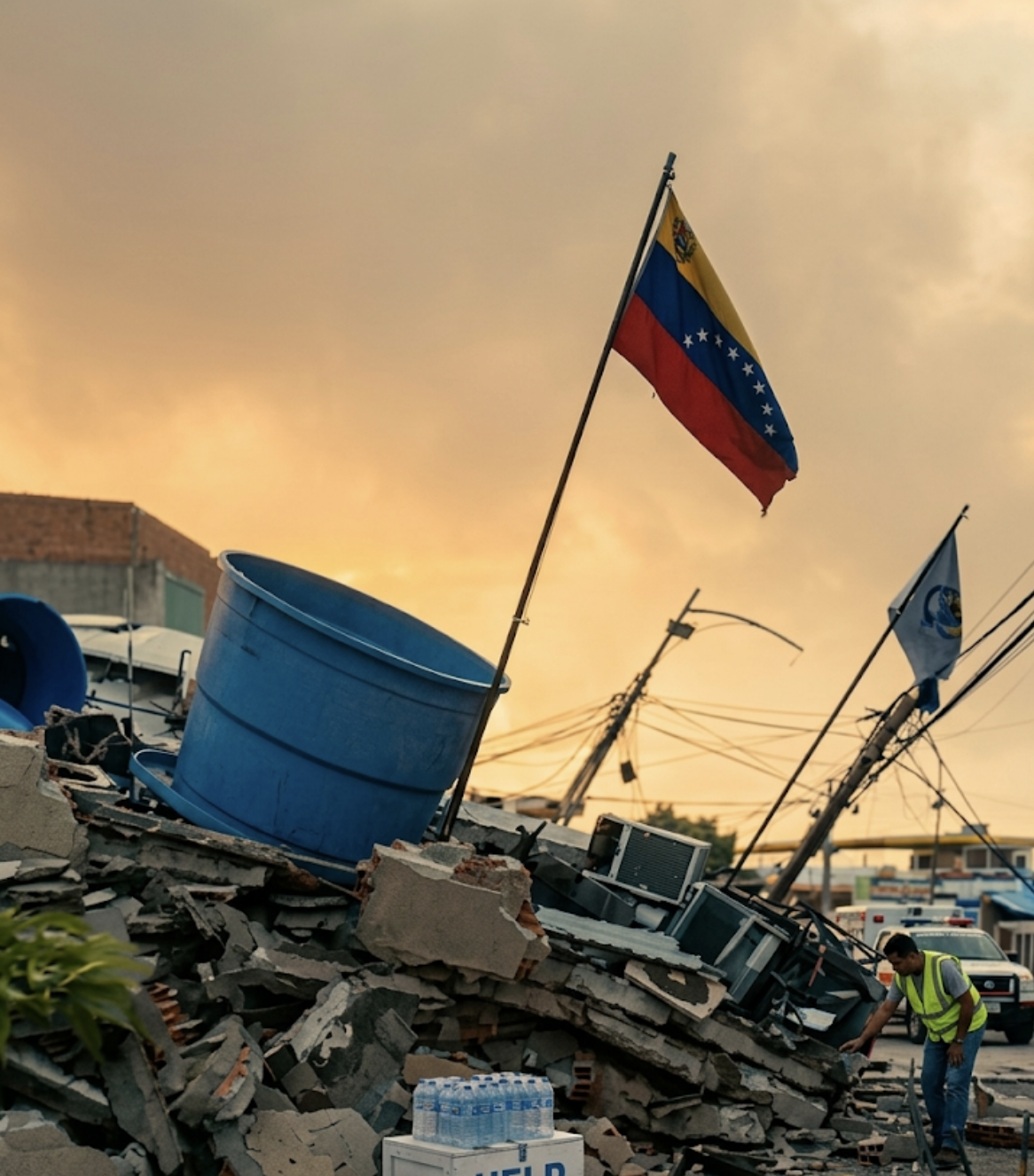
On June 24, 2026, two consecutive earthquakes of magnitude Mw 7.2 and Mw 7.5 — separated by just 39 seconds — struck north-central Venezuela, making them the most powerful seismic events recorded in the country in over a century. The USGS‘s Prompt Assessment of Global Earthquakes for Response estimates a 56% probability that economic damage will fall between $100 million and $100 billion.
These effects are not only the result of the extraordinary magnitude of these earthquakes but also of Venezuela’s entrenched institutional fragility. Even before June 24, the country faced significant challenges due to its designation as a fragile state, particularly in critical areas such as infrastructure. The two earthquakes will considerably deepen this fragility.
Under these circumstances, it is essential to mobilize resources to address the emergency. It is equally necessary to put in place efficient and transparent mechanisms for managing those resources. This post examines the most relevant institutional considerations for channeling and administering relief funds through a humanitarian fund, drawing on examples such as the Haiti Reconstruction Fund (HRF) and the lessons they offer for maximizing resource management effectiveness.
Resources for addressing the emergency
The resources available to address the emergency fall into two broad categories: (i) own-source resources and (ii) external resources.
Own-source resources include external financial assets. At a general level, the following sources can be identified: (i) revenues from oil and other commodity exports, administered under Executive Order No. 14,373 of the United States Government; (ii) Special Drawing Rights (SDRs) from the International Monetary Fund, totaling approximately USD 4.9 billion — of which the interim Venezuelan authorities announced on June 25, 2026 an initial allocation of USD 200 million to the reconstruction fund; and (iii)gold deposits held by the Central Bank of Venezuela at the Bank of England. The Venezuelan Government may also hold other assets in foreign bank accounts whose use is restricted by administrative or judicial measures.
External resources fall into two categories: (i) non-reimbursable resources provided by international organizations, states, non-governmental organizations, and similar entities; and (ii) reimbursable resources, that is, loans.
Non-reimbursable resources correspond broadly to humanitarian aid channeled voluntarily. A mechanism already in place is the Venezuela Humanitarian Fund (VHF), established in 2020 by the United Nations Office for the Coordination of Humanitarian Affairs.
Reimbursable resources or loans may be harder to access given Venezuela’s institutional and economic fragility, now further aggravated. One avenue worth exploring is the IMF’s Rapid Financing Instrument (RFI), as was the case in Ecuador in 2016.
Technical assistance from multilateral organizations is also particularly valuable for addressing the consequences of the earthquakes and defining the recovery plan.
An important consideration is the potential obstacles that U.S. economic sanctions may pose to the channeling and management of resources, as illustrated by the case of Syria. In this regard, and in accordance with OFAC’s policies on humanitarian matters, the general licenses needed to clear those obstacles should be carefully evaluated.
Indeed, on June 25, OFAC issued General License 60, authorizing all the prohibited transactions related to earthquake relief efforts in Venezuela, including “the processing or transfer of funds on behalf of third-country persons to or from Venezuela”.
At the same time, the sanctions regime may also serve as an enabling factor for the Fund: Executive Order No. 14,373 protects the assets of the Venezuelan Government held in the United States against third-party attachment measures, which offers donors a meaningful layer of legal security.
Venezuela Reconstruction Fund
The institutional fragility that the events of June 24 have further compounded poses significant constraints on the transparent and efficient management of any resources channeled to address the humanitarian emergency.
As noted by the International Monetary Fund, bad governance (including corruption) not only “increases the number of disaster-related deaths” but also hampers the effectiveness of the recovery policies.
Since that fragility cannot be remedied in the short term, one alternative — inspired by the Haiti model — is to create a Reconstruction Fund: a humanitarian fund administered by international organizations.
Establishing this Fund offers four institutional advantages: (i) it provides a short-term workaround for the Venezuelan Government’s institutional weakness; (ii) it facilitates coordination among donors and contributing institutions; (iii) it enables resource management in accordance with the humanitarian principles (in particular, humanity, impartiality, neutrality, and independence); and (iv) administering the Fund from the United States provides asset protection mechanisms under Executive Order No. 14,373.
The following are the key institutional components required to establish the Fund:
- Establishment of a central coordinating body within the Venezuelan Government, with broad-based, technical membership (the National Reconstruction Authority). Following Nepal‘s example, the Venezuelan Government can establish a body to coordinate humanitarian policies. Given the current institutional and democratic fragility, the composition of this body must be inclusive and technically grounded, reflecting broad political consensus and complying with humanitarian principles. These governance rules can reduce coordination failures and trust deficits stemming from political dysfunction, as seen in Nepal and Haiti. A key priority is strengthening the Authority’s capacity through information and communications technology.
- Establishment of the Fund under international administration. The Venezuelan Government should formally request that international organizations create and administer the Fund. In Haiti, the World Bank and the Inter-American Development Bank played a central role, accumulating experience directly relevant to Venezuela.
- Fund governance. Decision-making authority should rest with an executive body with inclusive, humanitarian-oriented representation. To prevent operational delays of the kind that occurred in Haiti, close coordination with the Venezuelan Government through the National Reconstruction Authority is essential.
- Administrative mandate. The Fund should have a clear mandate that defines coordination mechanisms for the channeling and disbursement of resources in Venezuela, in line with humanitarian principles. Again, coordination with the National Reconstruction Authority is essential. To that end, it will also be necessary to strengthen the Venezuelan Government’s institutional capacity to implement procurement procedures effectively and transparently.
- Financial management. Financial management may be routed through bank accounts in the United States to ensure adequate asset protection under Executive Order No. 14,373.
- Community participation. Resource administration should be oriented toward strengthening the capabilities and resilience of project beneficiary communities, promoting civic participation in line with the principles of humanity, impartiality, neutrality, and independence. A particularly effective tool is the direct transfer of financial resources to private property owners.
- Decentralization. The efficiency of reconstruction policies can be enhanced through decentralization mechanisms without prejudicing the Authority’s coordinating role. This requires strengthening Venezuela’s decentralization framework through free and organized civic participation.
- Host state. Drawing on the lessons of the Syria and Turkey cases, the presence of a host state could help coordinate humanitarian policies, particularly given Venezuela’s institutional fragility. The United States could assume this role, given its current policy framework on Venezuela as set out in Executive Order 14,373.