The Regulatory Changes in the Governing Law and Dispute Resolution of Venezuelan Oil, Gas, and Mining Contracts
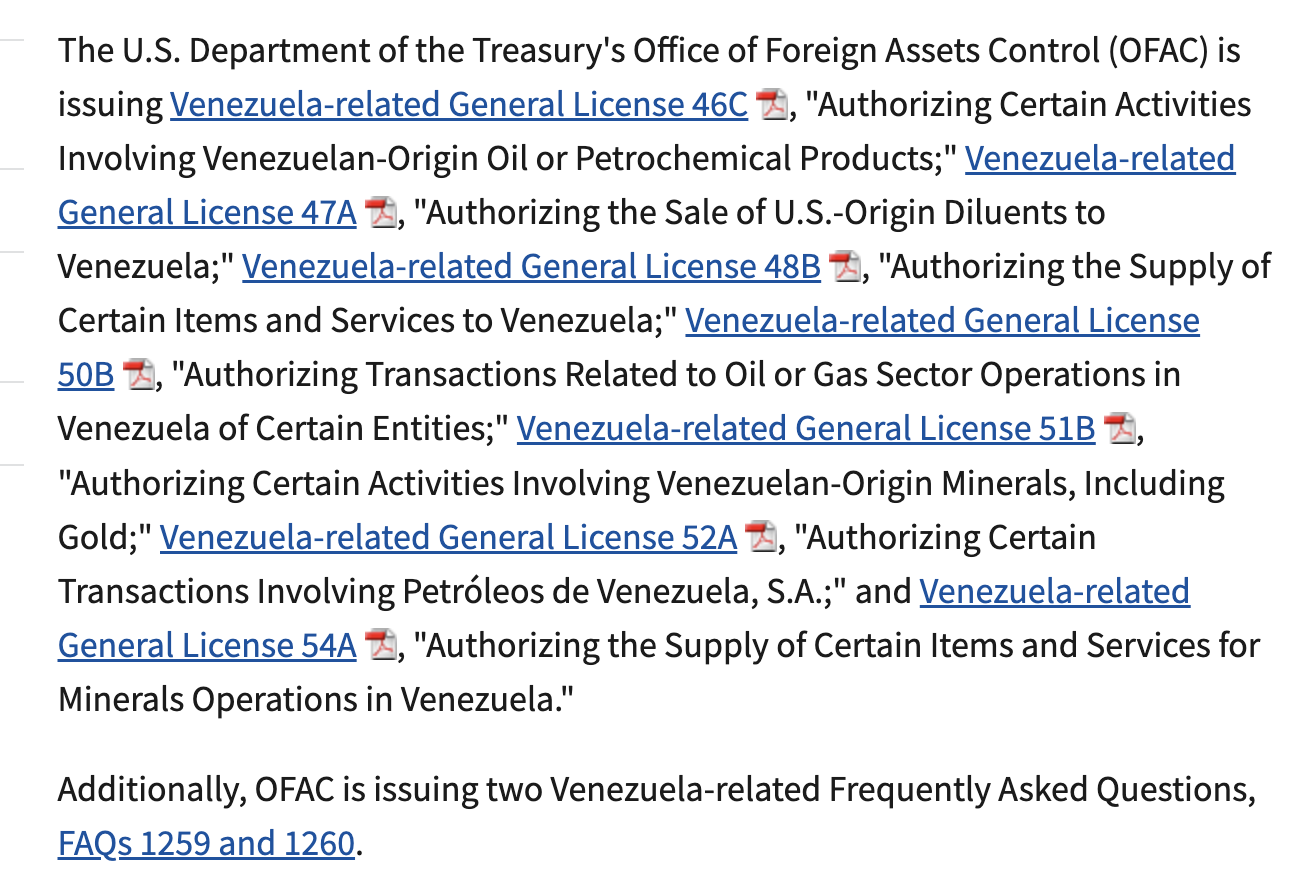
On June 10, 2026, OFAC published amended versions of General Licenses 46C, 47A, 48B, 50B, 51B, 52A, and 54A for the Venezuelan extractive sectors. The changes clarify and modify aspects of the governing law and the dispute-resolution mechanism, both of which have raised issues under Venezuelan law.
The original licenses provided that the contracts signed by the Government of Venezuela in the hydrocarbons and mining sectors should be governed by U.S. law (federal or state), while any contractual “dispute resolution under the contract” was to occur in the United States. The reform of the Hydrocarbons Framework Law suggests that contracts should be governed by Venezuelan law, while disputes should be adjudicated only by Venezuelan courts or through arbitration. A similar regulation can be found in the Mining Framework Law. The draft of the CPP contract added confusion while reinforcing Venezuela as the governing law, with an arbitration clause under the UNCITRAL Arbitration Rules.
The amended licenses have introduced two changes that may facilitate harmonization with Venezuelan law.
The first change concerns the governing law. Originally, the licenses provided that “any contract for such transactions with PdVSA or PdVSA Entities specify that the laws of the United States or any jurisdiction within the United States govern the contract”. Now, the licenses provide that the “terms of the contract be construed and interpreted in accordance with the laws of a state or other jurisdiction within the United States”. The modification clarifies that Venezuelan law will always apply to the contract, particularly with respect to public law provisions, as the new licenses state in their notes. In turn, the U.S. law applies to the contractual provision. This was the same recommendation that I formulated elsewhere. The U.S. and Venezuelan laws are complementary. As was clarified in the FAQ 1260:
“This requirement means that the laws of a state or other jurisdiction within the United States must govern questions of contract law between the parties relating to the contract, including interpretation, contractual performance obligations, breach, contractual remedies, payment obligations, termination, validity, assignment or novation, and enforceability of the contract.
The requirement permits the inclusion of contract terms that recognize that certain aspects of the underlying activity in Venezuela may be subject to applicable Venezuelan law and regulations, including laws and regulations governing the exercise of Venezuela’s sovereign regulatory authority, administrative permits and licenses, concessions, labor, environmental, health and safety, and other mandatory regulatory requirements”.
The second change concerns the dispute resolution mechanism. The prior provision, which stated that “any dispute resolution under the contract occur in the United States”, was replaced by the following provision: “dispute resolution proceedings relating to the contract occur in the United States, the United Kingdom, France, or Singapore”.
The amended licenses address many of the incompatibility issues that could lead to contracts that, while complying with OFAC regulations, contradict Venezuelan law. Nevertheless, many potential contradictions remain to be resolved under Venezuelan law. I want to highlight the three most important.
The first condition to avoid conflicts with Venezuelan law is to clarify the governing law and the dispute-resolution mechanism under the hydrocarbons and mining laws. Even under the new licenses, there may be doubts about whether U.S. laws govern contractual aspects of hydrocarbon and mining operations, while foreign dispute-resolution mechanisms may conflict with the legal provisions. The best way to implement this clarification is through a legislative reform.
Once this aspect is clarified, the second condition is to ensure that the hydrocarbons and mining contracts comply with the general licenses and Venezuelan law. That was not the case with the CPP model, which increased the compliance risk regarding sanctions regulations. To that end, it is necessary to draft contracts that comply with OFAC’s regulations.
Finally, the recognition that Venezuelan public law always applies to the contract, in areas such as regulatory powers, administrative permits and licenses, concessions, labor, environmental, health, and safety, creates a risk. A private investor could be subject to burdensome Venezuelan regulatory requirements that diminish the protection of their contractual rights. Because the final purpose of the licenses is to reduce exposure to regulatory risk in Venezuela, it will be necessary to advance comprehensive regulatory reform in Venezuelan administrative law while expanding the scope of investment treaty protections.
Annex
Table of Licenses Modified
| License | Subject | Effective | Prior Provision | Revised Provision |
| 46B → 46C | Venezuelan-Origin Oil / Petrochemicals | June 10, 2026 | Dispute resolution: U.S. only | Dispute resolution: U.S., UK, France, Singapore |
| 47 → 47A | Sale of U.S.-Origin Diluents to Venezuela | June 10, 2026 | Dispute resolution: U.S. only | Dispute resolution: U.S., UK, France, Singapore |
| 48A → 48B | Supply of Certain Items & Services to Venezuela | June 10, 2026 | Dispute resolution: U.S. only | Dispute resolution: U.S., UK, France, Singapore |
| 50A → 50B | Oil/Gas Operations – Named Entities (BP, Chevron, Eni, Maurel & Prom, Repsol, Shell) | June 10, 2026 | Dispute resolution: U.S. only | Dispute resolution: U.S., UK, France, Singapore |
| 51A → 51B | Venezuelan-Origin Minerals (incl. Gold) – Purchases | June 10, 2026 | Dispute resolution: U.S. only | Dispute resolution: U.S., UK, France, Singapore |
| 52 → 52A | Transactions Involving PdVSA (General) | June 10, 2026 | Dispute resolution: U.S. only | Dispute resolution: U.S., UK, France, Singapore |
| 54 → 54A | Supply of Items & Services – Minerals Operations | June 10, 2026 | Dispute resolution: U.S. only | Dispute resolution: U.S., UK, France, Singapore |