OFAC General License 58 and the Restructuring of Venezuelan Debt. Some legal implications.
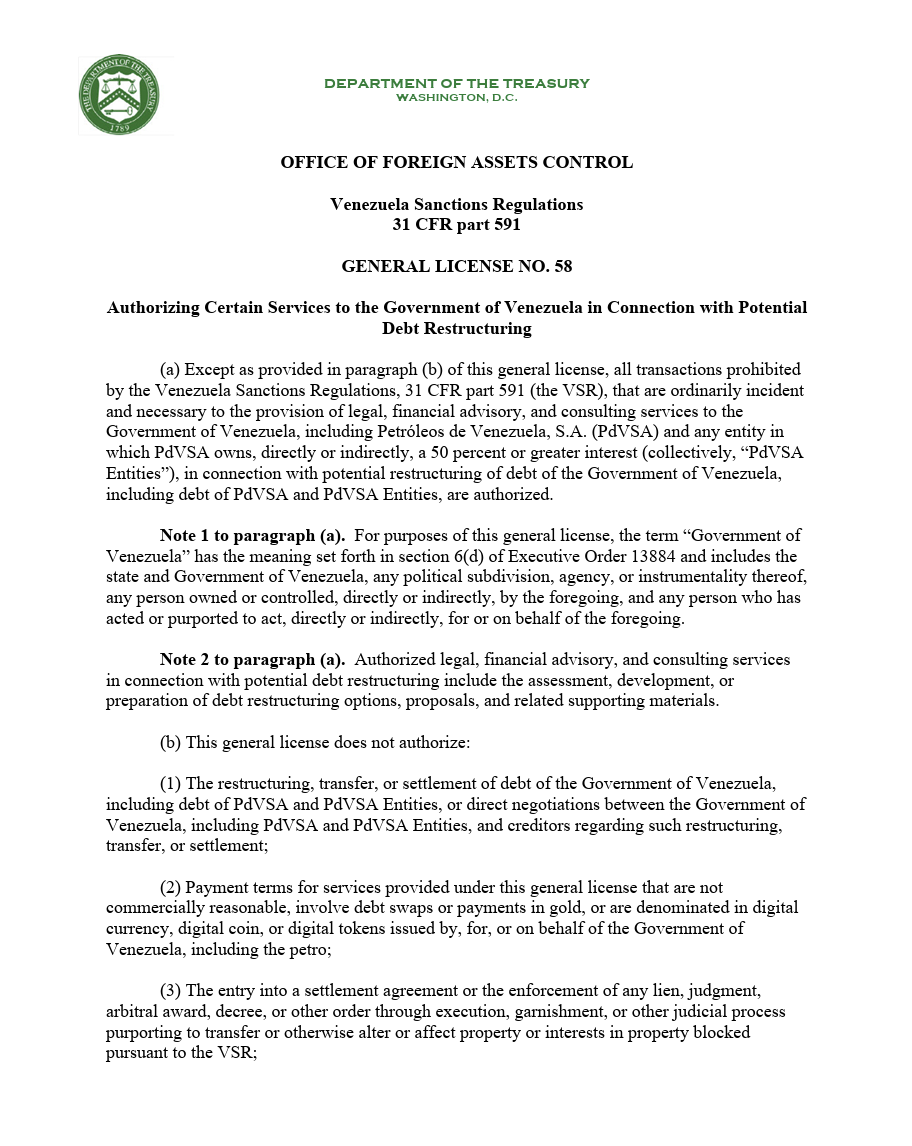
On May 5, 2026, the Office of Foreign Assets Control (OFAC) of the U.S. Department of the Treasury issued General License 58 (GL 58), authorizing the Government of Venezuela to engage in transactions otherwise prohibited under U.S. sanctions regulations for the purpose of contracting professional services related to the restructuring of its public debt.
Despite its narrow scope, GL 58 may mark the first step toward the restructuring of Venezuela’s public debt following the default that began in 2017 with respect to Venezuelan and PDVSA Eurobonds and subsequently extended to other non-financial debt claims.
I. The Scope of the Authorization
GL 58 authorizes certain transactions otherwise prohibited under the U.S. sanctions framework, which generally bars the Government of Venezuela from engaging in transactions in the United States or with U.S. persons. Specifically, the License authorizes the Government of Venezuela to contract professional services in connection with the potential restructuring of its public debt (Paragraph (a).
From a legal standpoint, four concepts must be delineated: Government of Venezuela, public debt, restructuring, and professional services.
The Government of Venezuela encompasses all entities and bodies of the Venezuelan public sector (Note 1 to Paragraph (a). This includes all entities and bodies covered by the Organic Law on Public Sector Financial Administration (LOAFSP, by its Spanish acronym) and, in particular, the Republic itself and State-owned enterprises, including Petróleos de Venezuela, S.A. (PDVSA) and Electricidad de Caracas (ELECAR), today the Corporación Eléctrica de Venezuela (CORPOELEC).
The term public debt comprises the universe of financial claims or monetary obligations of the Venezuelan public sector. Because GL 58 does not exclude any obligation, the authorization extends, in general terms, to the entire debt, encompassing both domestic and—particularly—external debt. It likewise reaches both non-financial and financial debt, including the bonds issued by the Republic, PDVSA, and ELECAR. Finally, the concept of public debt also covers bilateral and multilateral debt.
The authorization extends to the “potential restructuring of the debt”. Under Articles 3, 57, and 60 of Regulation No. 2 to the LOAFSP, this concept covers (i) any transaction designed to extinguish debt through the issuance of new debt, including exchange and consolidation operations; and, more broadly, (ii) any transaction that modifies the original terms of the debt, such as a reduction in the interest rate or an extension of the maturity.
Finally, the professional services that may be contracted under Note 2 to Paragraph (a) include legal, financial, advisory, and consulting services—that is, all professional services necessary for the potential restructuring of the debt, including the study, development, and preparation of restructuring options and proposals, together with their corresponding supporting materials.
Services may not be procured from firms organized in China, Iran, Cuba, North Korea, or Russia, nor from sanctioned consultants (Paragraph (b), subparagraphs (4) and (5).
This authorization is without prejudice to the special legal regime governing settlements that may, where appropriate, be entered into to resolve pending litigation before U.S. courts brought by creditors of the Government of Venezuela, which—depending on the circumstances—will require separate OFAC licenses.
II. Professional Services for Debt Restructuring vs. Debt Restructuing Itself
GL 58 authorizes contracting only for professional services that may result in studies, proposals, or options for debt restructuring. It does not authorize negotiations with creditors or the execution of settlements or comparable agreements regarding creditor claims (Paragraph (b), subparagraphs (1) and (3).
Formally, therefore, GL 58 does not authorize the Government of Venezuela to renegotiate its public debt, as the prohibitions stemming from the U.S. sanctions framework remain in force.
It is important to recall that Venezuela’s Eurobonds are subject to a special regime under the U.S. sanctions framework. Secondary-market transactions are authorized by General Licenses 3I and 9H. At the same time, General License 5W temporarily bars holders of the PDVSA 2020 Bonds from exercising rights over the 51% equity interest in CITGO Holding, Inc. pledged as collateral.
Likewise, within the framework of Executive Order 14373, several general licenses issued in the hydrocarbons and mining sectors—including General Licenses 49A, 50A, 51A, 52A, and 55A—preserve the prohibitions that prevent debt renegotiation, including the implementation of in-kind payment mechanisms.
GL 58, accordingly, does not alter the general principle derived from Executive Order 14373, under which transactions aimed at renegotiating or paying the debt remain unauthorized.
In any event, as a practical matter, the prohibition on restructuring or renegotiating the public debt has limited operational impact, since any such restructuring requires preparatory steps—particularly the determination of Venezuela’s total public debt. GL 58 thus facilitates restructuring by allowing the hiring of professional services required for those initial steps.
III. Examples of Professional Services That May Be Contracted
One of the professional services that may be contracted is the reconciliation of the public debt—that is, the determination of the total amount of the monetary obligations of the public sector, including, in particular, so-called non-financial debt grounded in diverse legal bases, such as contractual breaches and claims arising from expropriations and similar measures. This reconciliation may include engaging accounting services to conduct an audit of the debt.
Notably, debt reconciliation is part of the technical assistance the International Monetary Fund could provide, particularly to prepare a Debt Sustainability Analysis (DSA).
Likewise, financial advisors may construct debt-renegotiation scenarios, defining sustainability thresholds and potential value-recovery mechanisms—for instance, mechanisms tied to oil production.
Finally, legal advisors may advance legal strategies related to debt restructuring. Once again, it bears recalling that these services are without prejudice to the legal advisory and representation services rendered to the Government of Venezuela before U.S. courts.
IV. The Principle of Transparency under Venezuelan Public Law
The contracts authorized by GL 58 are governed by Venezuelan public law, particularly the regulations on public procurement and the management of public assets. Under Articles 141 and 311 of the Venezuelan Constitution, all such contracts must comply with the principle of transparency, which is reinforced by the LOAFSP and by the legal regime governing public assets and the prevention of corruption.
An aspect of growing importance in the context of public debt—and of its restructuring—is precisely the principle of transparency, which must inform even the preparatory stages of the process.